
A ring of real wood slices — each one a small cross-section of a branch, each center
decorated differently — arranged into a circular mandala on linen. Here is how to make
it look like it belongs on your wall.
ost decorative art comes with a price tag but not an instruction manual. You bring it home, hang it on the wall, and hope it works. This handmade wood-slice painting is different — not because it is difficult, but because it is genuinely three-dimensional and made from real natural materials. That means the rules for styling it are slightly different from a flat canvas print. Get them right, and this piece becomes the kind of focal point that makes a room feel considered. Get them wrong, and it can feel like an afterthought.
This guide walks through the artwork itself, then lays out five practical styling rules — each one illustrated by a real room where the piece has been placed. By the end, you will know exactly where to hang it, what to put around it, and how to light it so it looks like it was made for your space.
◯ ◯ ◯
What You Are Working With
Before styling, it helps to understand what the artwork actually is. This is not a print. It is a hand-assembled composition built from three natural elements:
The Materials
- Wood slices — cross-sections of small branches and twigs, each sanded to show natural growth rings. Sizes range from tiny twig cuts to larger branch sections.
- Decorated centers — every slice has a unique center: dried seed clusters, small yellow accent dots, curled wood-shaving spirals, or plain natural pith. No two are alike.
- Linen ground — a soft, warm beige linen canvas provides a textured background that makes the raised wood slices appear to float.
- Circular composition — the slices are arranged in a dense ring with a hollow center, creating a mandala-like form that draws the eye inward.
The hollow center is the secret to this piece. It is not a solid circle — it is a ring. That means the wall color behind the center becomes part of the artwork. Choose your wall color, and you are partly choosing how the painting looks.
The square format (80x80 cm) and the circular subject create a natural frame-within-a-frame effect. The wood frame around the linen, the ring of wood slices, and the hollow center create three concentric circles of attention. This is a piece that wants to be centered on a wall, not tucked into a corner.


◯ ◯ ◯
The Five Styling Rules
1
Center It. Really Center It. Entryway
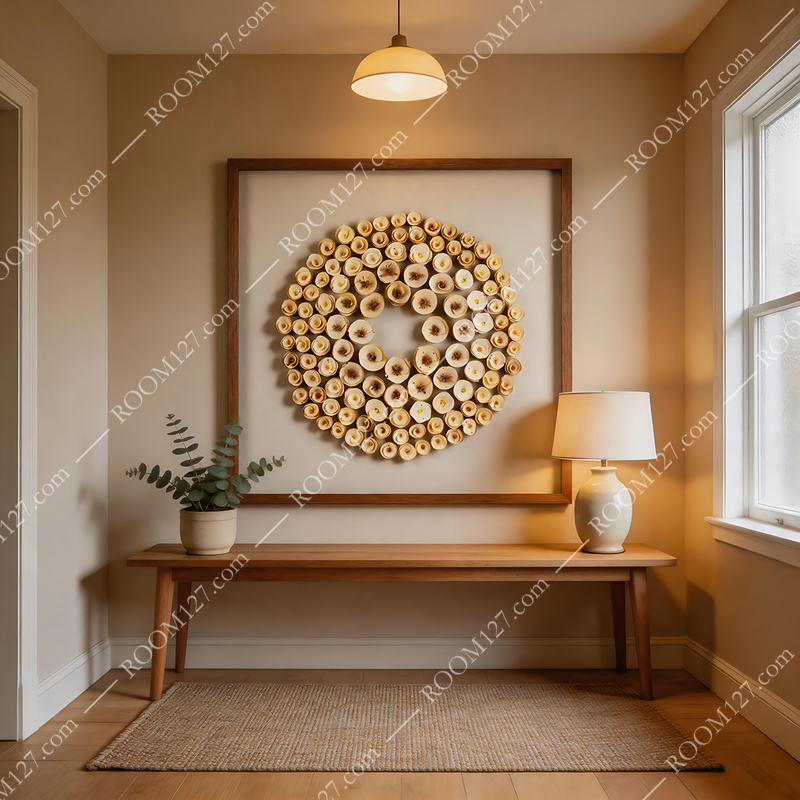
This is the single most common mistake. Because the artwork is a circle inside a square, it wants perfect symmetrical centering on the wall. Hang it above a console table, centered between two wall sconces or beneath a pendant light, and the circular composition echoes the symmetry of the space. In an entryway with a wooden console, a ceramic lamp, and a eucalyptus plant, the centered painting becomes the first thing visitors see — and the last thing they remember. Avoid off-center placement unless the surrounding furniture is deliberately asymmetrical.
2
Pair With Natural Materials — and One Cool Contrast Hotel Lobby
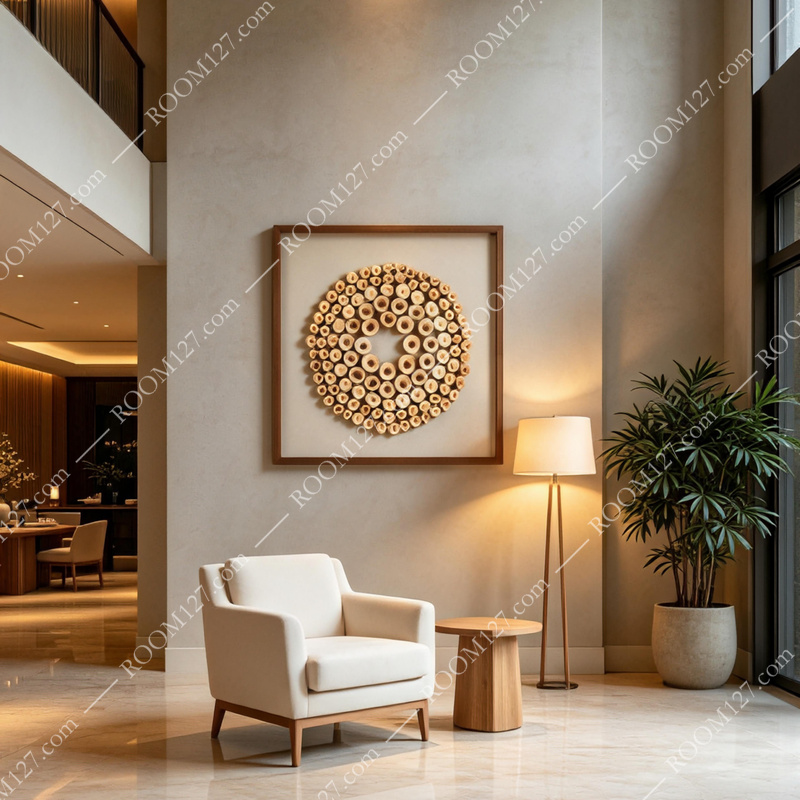
The artwork is made of wood and linen, so it naturally pairs with wood, rattan, linen, jute, ceramic, and stone. In a hotel lounge with a cream armchair, a wooden side table, a floor lamp, and a large potted plant, the painting feels like it belongs to the material family of the room. But here is the designer trick: add one cool contrast. A polished marble floor, a stainless steel detail, or a cool gray wall prevents the all-natural palette from feeling flat. The contrast makes the warmth of the wood stand out more, not less.
3
Let It Warm Up a Cool, Hard Space Elevator Lobby
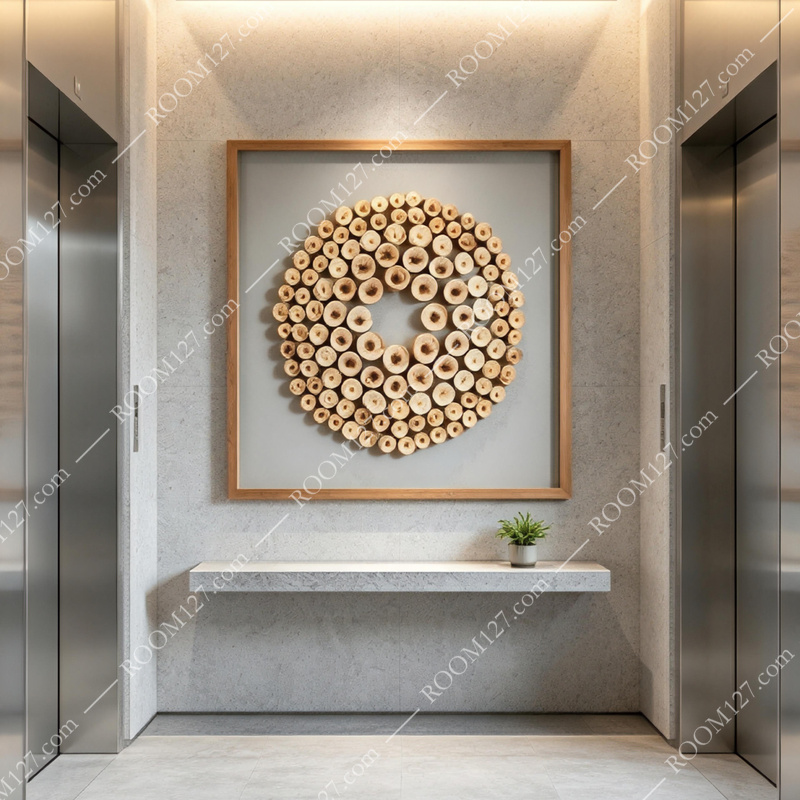
Some rooms are inherently cold — think stainless steel elevators, concrete walls, stone floors, and fluorescent lighting. This painting is one of the best possible artworks for those spaces because it is pure organic warmth. In an elevator lobby with stone walls and a floating concrete shelf, the wood-slice ring cuts through the cold like a small fire. The key is to keep the surrounding decor minimal — one small plant on the shelf, nothing else. Let the painting do all the warming. If you add too many warm accessories, the effect becomes decorative rather than transformative.
4
Light It From Above, Not From the Front Library / Study
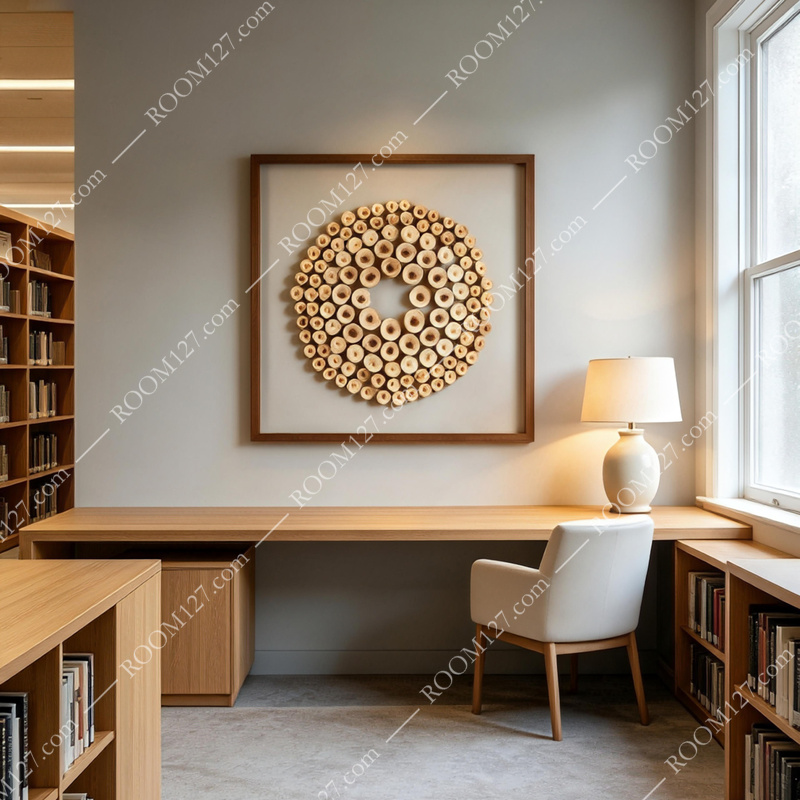
Because the wood slices are raised from the linen surface, they cast small shadows. Lighting from above — a pendant light, a track spotlight, or a picture light mounted above the frame — makes those shadows visible, and the shadows are what give the piece its three-dimensional depth. In a library with wooden bookshelves, a long wooden desk, and a table lamp beside the painting, the overhead light turns the wood-slice ring into a subtle relief sculpture. Avoid flat front lighting (like a camera flash or a directly facing ceiling fixture) — it flattens the shadows and makes the piece look like a print. A 30–45 degree angle from above is ideal.
5
Keep the Surrounding Wall Clear — This Is a Solo Performer Waiting Room / Lounge
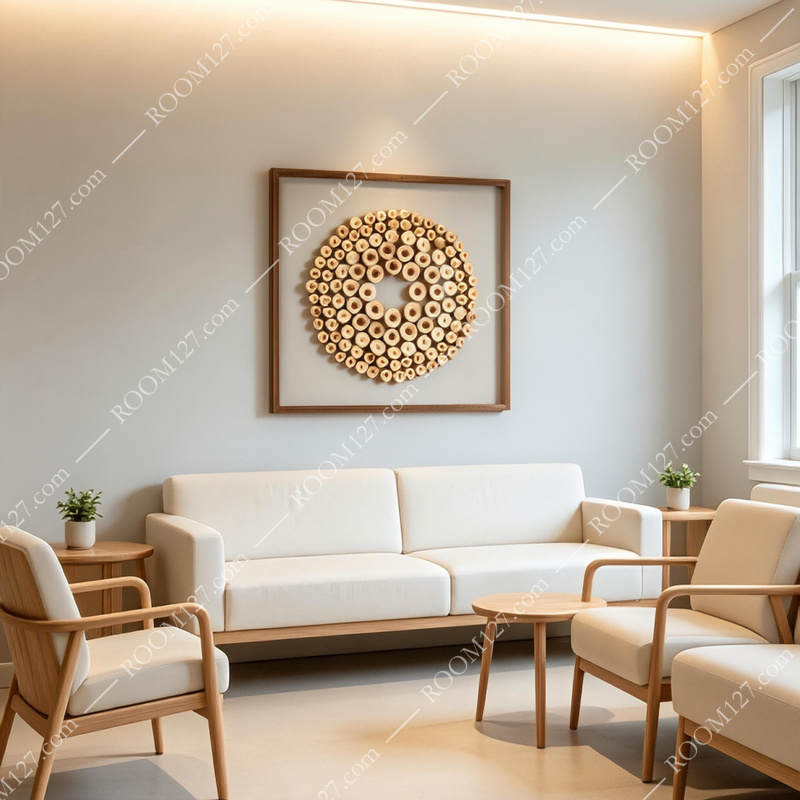
Some artworks work in gallery walls — clusters of multiple pieces, shelves of objects, layered arrangements. This one does not. It is a solo performer. The circular composition is so visually complete that adding other art or objects on the same wall creates competition. In a waiting room with cream sofas, wooden armchairs, and small plants on side tables, the painting hangs alone on a plain wall, and that is exactly why it works. Give it at least 60 cm of clear wall space on all sides. Resist the urge to add a gallery wall around it. The empty space is part of the styling.
◯ ◯ ◯
Where It Works Best
Beyond the five rules, certain room types are naturally suited to this piece:
Commercial & Public Spaces
In a retail store window, a shopping mall corridor, or a hotel lobby, the painting's natural materials and circular form create a moment of calm in a high-traffic environment. It works particularly well in spaces with wood, stone, or concrete architecture — the organic ring softens the hard lines of commercial design. In a retail setting, it also signals craftsmanship and natural values to customers.
Residential Spaces
In a home, it excels in entryways (first impression), living rooms (above a sofa or console), and studies or libraries (above a desk). The warm wood tones pair with almost any neutral palette — cream, beige, warm gray, taupe. In a bedroom, it can work above a bed if the headboard is low and the wall is plain, but avoid placing it where it will be partially hidden by a tall headboard.
◯ ◯ ◯
Care & Placement Notes
Humidity
Natural wood and linen prefer stable, dry environments. Avoid bathrooms, kitchens near steam, or exterior walls with condensation. A dehumidifier is helpful in damp climates.
Cleaning
Dust gently with a soft, dry brush or a vacuum on low suction with a brush attachment. The wood-slice edges and decorated centers are delicate — never use water, cleaning spray, or a damp cloth.
Sunlight
Avoid direct, harsh sunlight for long periods — it can fade the linen and dry out the wood over time. Indirect natural light or warm artificial light is ideal. Rotate if one side gets more sun.
Hanging
Use sturdy wall anchors appropriate for the frame weight. Hang so the center of the artwork is at 145–155 cm (57–61 inches) from the floor. Because it is a square, it will feel centered whether your furniture is wide or narrow.
◯ ◯ ◯
Final Thought
Styling art is not about following rules rigidly — it is about understanding what a piece needs and then giving it room to do its work. This wood-slice circle needs centering, natural materials, overhead light, and clear wall space. Give it those four things, and it will reward you with a quiet, organic focal point that makes any room feel more grounded, more human, and more like home.
The best part? Because every wood slice is a real cross-section of a real branch, and every center is decorated by hand, no two pieces are identical. The one on your wall will be the only one like it — a small circle of real nature, made by hand, hanging where you live.
Available now. Each piece is hand-assembled from real wood slices on natural linen, framed in a warm wood profile. Wood-slice sizes, grain patterns, and center decorations will vary — every circle is unique.