
The Woman Who
Never Turns Around
A back-view figure painting for rooms that need quiet, not decoration.
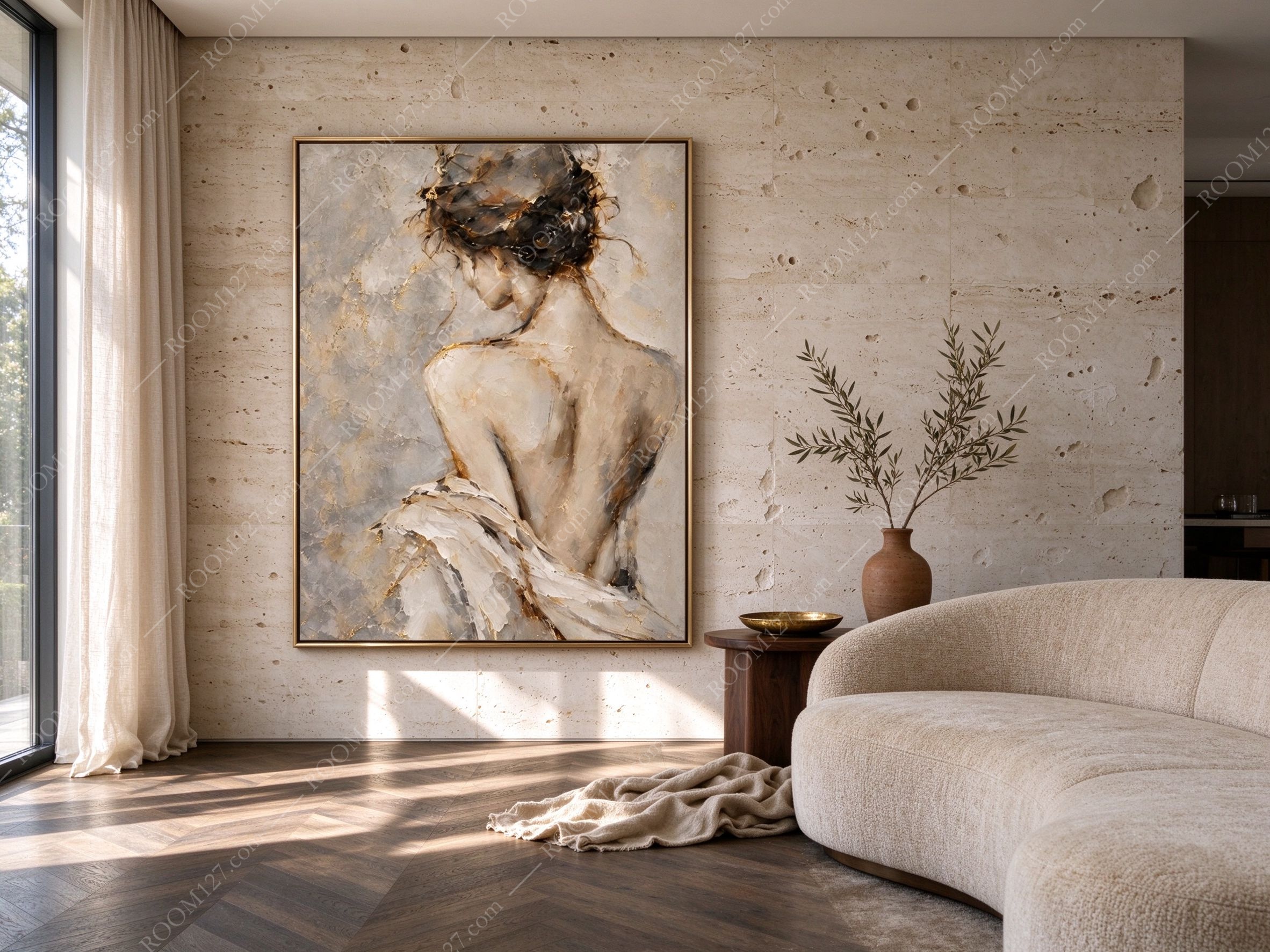
You walk into the room and stop. Not because the room is beautiful — although it is — but because of the woman on the wall.
She is facing away from you. Her hair is pinned up in a loose knot, dark umber and black, with strands escaping at the nape of the neck and catching a little gold. Her back is bare. A white cloth has slipped from one shoulder and pooled at her waist in thick, dry folds. She is not looking at you, and she is not going to.
That's the whole painting. No face. No hands. No story you can name. Just a back, a knot of hair, a falling cloth, and a background of pale grey marble.
And yet it is the first thing you see in every room it hangs in — before the sofa, before the fireplace, before the view out the window. Which is strange, because most art has to shout to get that kind of attention.
The story behind it
There were eleven of them.
The painter pinned each study to the studio wall — same woman, same pose, same window light — and rejected each one for a different reason. The first was too polished; the shoulder looked like a mannequin. The fourth had a beautiful back and dead hair. The seventh was technically perfect and completely silent. The ninth had too much gold in it, so the woman disappeared and the metal took over.
The eleventh was the one. Not because it was the most accurate, but because it was the least finished in exactly the right places: the fabric left raw, the edge of the shoulder softened, the hair still wet and moving. She had stopped posing and started leaving.
What the camera doesn't show
Detail notes
Product photos flatten a painting.
These are the things you only notice standing in front of it.
🖌️ The hair is built, not drawn.
Up close it is almost abstract: a dozen palette-knife strokes stacked over each other, black and burnt umber with a few threads of raw sienna pulled through. From two metres away it resolves into a knot. From thirty centimetres it falls apart again. That's intentional. The painter let the hair stay unresolved because a finished knot would have made her look posed.
🪞 The back has almost no outline.
Look for the line that separates her body from the background. There isn't one. The spine, the shoulder blade, the curve of the waist — all of it is described by shadow rather than line. Under the pale skin the painter laid a warm ochre base, which is why she reads as warm even in a cold room. This is old-fashioned training, and it is the reason the figure looks like a body and not a shape.
🌊 The cloth is dry and fast.
The white drape across her hip is not smooth. It has bristle marks, skipped paint, and edges where the brush ran out. Follow the direction of the strokes: they move down and away, the way fabric actually falls. Step back and it becomes silk. Step close and it is just paint — and somehow that's more convincing.
✨ The gold never becomes decoration.
This is the detail that separates this piece from cheaper metallic prints. The gold does not sit on top like a sticker. It appears in fragments — a fleck at the edge of the hair, a thin line along the shoulder, a glint on a fold of cloth, dust in the background. It behaves like light, not like leaf. Which means it changes with the room's lighting instead of fighting it.
🖼️ The frame is slim bronze, not gold-tone plastic.
Roughly two centimetres, antique bronze with a faint patina, matte rather than reflective. It disappears at a distance and gives the canvas a quiet edge up close. In the Milan photograph it also explains why the painting survives a wall of dark walnut: a bright frame would have looked cheap there.
Faces on walls ask to be looked at.
A back asks for nothing — and gets it anyway.
Why a back view changes a room
The psychology of no eye contact
Hang a portrait with a face and something specific happens: the face watches. Guests make eye contact with it, comment on it, sometimes feel slightly judged by it. It becomes a conversation piece — which is fine, if you want a conversation.
A figure facing away does something different. It gives you company without demanding a response. In a bedroom it feels like presence. In a hallway it feels like someone just walked past. In a hotel lobby it gives guests a moment of privacy inside a public space. Nobody has to say anything about it, and that's the point.
There is also a compositional reason it works so well on a wall. The canvas is vertical, and the figure fills it from the crown of the head to the waist, slightly off-centre. Your eye travels down her spine, and the room inherits that vertical pull — ceilings read higher, narrow walls read deeper. It is architecture disguised as a nude study.
And the palette is deliberately unhelpful to decorators. Cream, pale grey, ochre, black, a little bronze. It will not clash with your rug, and it will not rescue a bad one either. It simply holds the room's temperature steady — which, in a space that already has good bones, is exactly what you want from art.
Six rooms, six different silences
Field notes
🏛️ Belgian minimal apartment
You enter and the wall is travertine — pitted, sandy, full of small holes. The painting hangs in the middle of it, and the beige sofa curves away underneath. Late afternoon sun cuts a hard diagonal across the floor and half the canvas. Her back goes warm, the background goes grey, the gold in her hair lights up for about forty minutes and then fades. Nobody in the room is talking.
🕯️ Milan dark penthouse
Dark walnut panelling, black marble floor, a leather bench, one brass picture light aimed down at the canvas. At night the room is basically a black box, and the painting is the only warm object in it. The light bar catches the top of her hair and the edge of the shoulder, and the rest of her dissolves into the wall. It looks like something a collector bought at auction and never told anyone about.

🪞 Parisian apartment
White moulding on every wall, a marble fireplace, herringbone parquet, one blue velvet chair pulled close. In daylight the painting goes almost pale — the grey background merges with the wall and only the hair and the fold of cloth stay dark. It doesn't compete with the cornices. It sits inside them.

🌿 Scandinavian limewash bedroom
Limewash walls, a linen bed, oak nightstands, nothing else. The painting hangs above the bed, slightly right of centre. In the morning the light comes in low and turns her back into the warmest surface in the room — warmer than the bedding, warmer than the floor. You wake up, and the first thing your eyes find is a shoulder.

🫒 Tuscan stone villa
Rough plaster, a stone arch, terracotta floor tiles, a potted olive tree, a glazed urn on a chest. The painting sits between the arch and the window. As the sun moves, the shadow of the window frame crawls across her back and leaves again. It is the only thing in this room that isn't centuries old, and it looks like it has always been there.

🌃 Top-floor apartment at dusk
Board-formed concrete, floor-to-ceiling glass, a city going blue outside. The painting is the only object on the wall, lit from above, and the candle and the thin brass floor lamp are the only other warm points in the frame. Standing there at seven in the evening, you understand why people pay for height: the room is quiet, the city is loud, and she is facing away from both.

Hanging it properly
Height, light, size
Height.
Centre the canvas at 145–150cm from the floor, or 15–25cm above the sofa back. Above a bed, leave 20–30cm between the mattress and the frame — closer than that and it looks like a headboard.
Width.
The painting should take up about two thirds of the furniture underneath. Over a 200cm sofa, use 80×120cm. In a hallway where there is no furniture to measure against, go taller than you think you need.
Light.
2700K warm white, aimed from above at roughly 30 degrees, never straight on. A slim picture light 15–20cm above the frame is ideal. Avoid direct west-facing sun — it will fade the ochre over a couple of summers — and avoid bathrooms with steam.
Care.
Dry microfibre brush, once a month, no water, no spray, no glass cleaner. If you must dust the frame, do it with a dry cloth and don't press. The texture on this canvas is part of the work; cleaning it flat is the one way to actually damage it.
Before you buy — a short checklist
✅ Yes, if the room already has good bones — decent sofa, real floor, warm lamps. This painting amplifies a room; it doesn't build one.
✅ Yes, if you want a bedroom that feels inhabited rather than styled.
✅ Yes, if you run a boutique hotel, a spa, a small gallery or a private dining room and need one wall to do the work of five.
❌ Not if the wall is already busy — patterned wallpaper, a gallery cluster, a huge TV. She needs empty space around her or she looks crowded.
❌ Not if you want a face looking back at you, or a nude you have to explain to your mother-in-law. This one is quiet enough to survive most family visits, but it is still a nude, and you should be comfortable with that before it arrives.
She'll never turn around.
That's not a flaw in the painting.
That's the whole reason you'll keep looking.